Gaja Uddharana Besha
Gajaudharana Besha is a special attire of Lord Jagannath in Jagannath Temple.
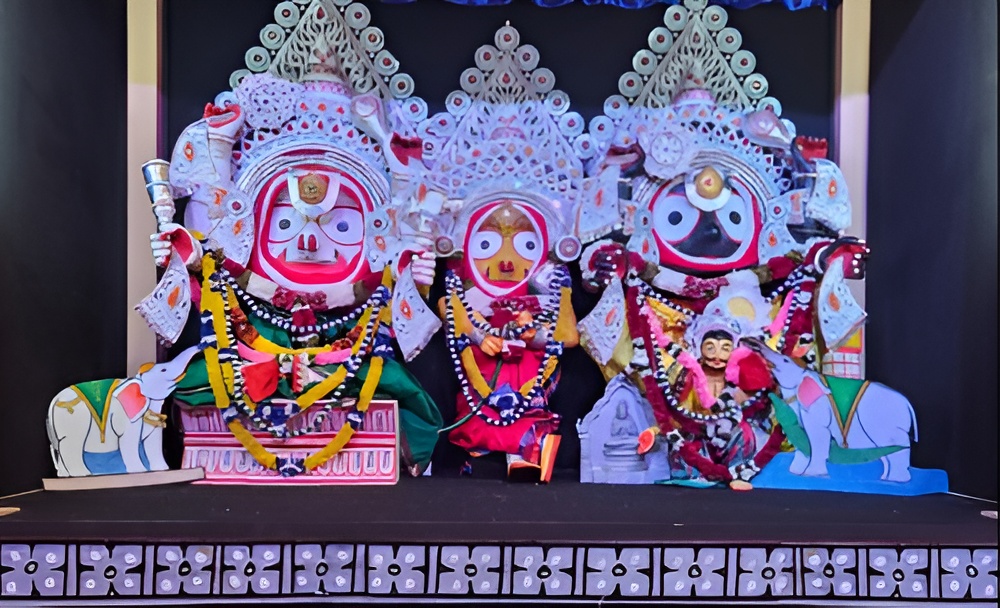
It depicts the story where Lord Vishnu saves the elephant Gajendra from a crocodile.During this besha, the deities are dressed to represent this mythological scene. It symbolizes divine protection and the Lord’s compassion toward devotees who seek help with faith.
When this besha observed ?
Every year, according to tradition, on the day of Magha Purnima, the Gaja Uddharana Besha (elephant-rescue attire) of the holy deities seated on the Ratna Singhasana in the Srimandir (Jagannath Temple) is performed. On this day, after the Madhyahna Dhupa (midday offering) of the deities is completed and the Mailam (changing of clothes) ritual takes place, the Sarbang ritual is performed. After this, the Gaja Uddharana Besha is carried out in three stages (three ‘bada’ or phases).
The story behind Gaja uddharana besha .
The story on which this Besha (attire/ritual) is based is found in the Second to Fourth chapters of the Eighth Skandha of the Srimad Bhagavata. It narrates that on Trikuta Mountain, which is surrounded by the Kshira Sagara (Ocean of Milk), there was a lake called Varuna Lake. While the king of elephants (Gajaraja) was bathing in this lake, a terrifying crocodile (Graha) living in the lake attacked him.
Due to the attack of the crocodile, Gajaraja was severely injured and suffered great pain. Seeing no way to escape or save himself from this danger, in great distress he prayed to Lord Purushottama (Lord Vishnu) for rescue.
People say that just like Mahaprabhu (Lord Jagannath), Mahalakshmi is also very skilled in creating playful disputes (Hata). But a compassionate mother like her, whom the whole world calls “Mother,” is rare in all the three worlds. She is the mother of the entire universe.
At a time when Mahaprabhu and Mother Lakshmi were engaged in a game of dice, the desperate prayer of Gajaraja (the king of elephants) was echoing in Vaikuntha. However, Mahaprabhu, who tests the patience and devotion of His devotees, was examining the devotion of His bhakta. But Mahalakshmi, being the universal mother, could not bear the suffering of a child. After all, what mother can ignore the pain of her child?
With a deeply moved heart, she requested Mahaprabhu to relieve Gajaraja from his suffering. Finally, the compassionate Hari, who loves the humble and the helpless, removed Gajaraja’s suffering. Responding to the prayer of Gajaraja, Lord Purushottama immediately appeared at Varuna Lake and rescued the elephant king from the attack.
In memory of this Puranic episode, from very ancient times the Gaja Uddharana Besha of the deities has been performed in the Srimandir (Jagannath Temple).
Important features of the Gaja Uddharana Besha
Based on the Gajendra Moksha Story
The Gaja Uddharana Besha is based on the story of Gajendra Moksha described in the 8th Skandha of the Srimad Bhagavatam. It depicts how Lord Vishnu (Purushottama) rescued Gajendra (the elephant king) from a crocodile.
Observed on Magha Purnima
This Besha is performed every year on Magha Purnima according to the traditional rituals of the temple.
Performed on the Ratna Singhasana
The ritual takes place when the deities sit on the Ratna Singhasana inside the sanctum of the temple.
Conducted After Midday Rituals
The Besha is performed after the Madhyahna Dhupa (midday offering) and Mailam (changing of clothes) rituals of the deities.
Representation of Divine Compassion
The Besha symbolizes the compassion of Lord Jagannath, who protects and rescues his devotees from danger, just as he saved Gajendra.
Very Ancient Temple Tradition
This Besha has been performed in the temple since ancient times and is an important part of the ritual traditions of the temple.
Symbolic Decoration
During the Besha, the deities are decorated in a way that symbolically represents the rescue of Gajendra, recalling the Puranic story.
Keywords:
gaja uddharana
gajendra moksha
Tags:
leela
protection